Pages

Showing posts with label activities. Show all posts

Saturday, April 9, 2011

Mac::Utilities::Grapher::AWESOME


Yesterday, I showed my Algebra 1 classes how to graph parabolas on Mac's Grapher utility. It was so much fun! Dept. Chair at my school doesn't like to use technology all that much - even though she DOES have an ELMO (uses it like an overhead by the way - she doesn't believe me when I told her you could put the ELMO any where in the room and it'll still project onto the screen ::shrug::).

Going to let them play with Grapher next week to discover the patterns between the graph and equation of a parabola. Gotta make it really structured though. Every time I've used the mobile lab, some stupid kid always ends up doing something they aren't supposed to do.

Friday, February 25, 2011

Student vs. Faculty BBall Challenge!

Why The Faculty Will Always Lose, Reason #212:

Student From The Top Of The Stands: (shouts at me during the warm up pre-game) Miss!! Go for a 3-pointer!

Me: What's a 3-pointer?

SFTOTS: It's where you shoot from the line!

Me: (looks at the crisscrossed gym floor) Which line?

SFTOTS: That one! No, THAT ONE!

Me: Kid, you've got to be more specific!


SFTOTS did eventually tell me which line was the 3-point line. Needless to say, I did not make the basket. Faculty lost, 51-30. It was awesome.

Sunday, February 6, 2011

Values, part 2

A perfectly valid reason: being able to put food on the table.

Awhile ago, I commented about wanting to perform this experiment on my Algebra Readiness students.

Well, this past Friday, I did. A mini version, that is. Most of the quizzes we give fro Algebra Readiness are written by one of my co-workers, who is an excellent teacher. She likes to put random "Starter Questions" for students to answer in the space directly under where they are supposed to write their names. Some sample questions from the past quizzes this year were:

What is your favorite color?
Pepsi or Coke?
What is your favorite candy?
Where would you like to travel?

The students like answering these questions - or I assume they do, since nearly everyone always writes something down pertaining to the Starter Question. It's pretty fun to read them.

The quiz this past Friday was an unplanned quiz that I ended up doing because the math instructional consultant for my school district asked to do a demo lesson for me on Thursday, and she mentioned a quiz to the students. I hadn't told her we would be doing a quiz. I think she just assumed because the lesson she demo-ed on was a mid-chapter review. However the current chapter is so short - only 4 sections - that all the AR teachers just agreed to skip the quiz, even though we all did a mid-chapter review lesson.

Anyway, we had a quiz. I didn't want to back out on that since I had the time and it was a good idea to quiz them before moving on to the next section's material anyway. Most did decently well, which is good.

But since this quiz didn't exist in the first place, I had to write it up myself. As I was writing it, I also took the opportunity to make my own Starter Question.

That is how the story finally comes full circle and relates back to the Scientific American article about students and their values. My question was:

What is your reason for doing well in school?

I did a little number crunching while grading these quizzes. Out of the 49 students who took the quiz, here were their answers:

3 said I don't know
3 said they just wanted to work hard/liked working
3 said they were doing it for the grades
4 wanted good jobs/money
4 wanted to be on sports teams and go to field trips (which require a certain GPA, as well as other things, at my school)
4 said they wanted to succeed/be somebody in life
5 said they wanted to please their parents OR to get their parents off their backs
7 said they wanted to go to college

If you are counting, that's 33 students with one of those above answers so far.

The remaining 16 left it blank.

As I said earlier, nearly all students write something when it comes to these Starter Questions. It's rare to have more than a handful who don't write anything at all. So why 16?

Possible reason #1: They don't know what their reason is, so left it blank.
Possible reason #2: They felt rushed on the quiz (I only gave them 15 minutes on 10 questions - unplanned quizzes are rushed, that's a lesson for me) and skipped it.
Possible reason #3: They don't really care about doing well in school, which is similar to the "I don't know" answer.

Weirdly, most students finished the quiz well within the time limit. So for the purpose of my experiment, I'm going to assume that these 16 blank answers are "I don't knows," making a total of 19 "I don't knows." This assumption may or may not be valid. Further study needs to be done - quite possibly in a more systematic and scientific way than this little mini experiment turned out to be.

19 out of 49 of my 8th graders say they don't know their reason for doing well in school. That's almost 39%.

Wow.

Saturday, January 22, 2011

Uptight spinster school marm says...

I will so go to hell for posting this picture here. But really, it speaks so very loudly.

Last night was the second 7th/8th grade dance of the year. As if it was even possible, students were nastier than at the first dance. The things I saw/disciplined for included, but not limited to:

- grinding
- bumping
- touching; of the inappropriate and the more innocent natures
- moshing
- mushing
- climbing
- swearing
- hollering
- PDA-ing
- excessive hip swinging
- excessive protesting for when they got caught and they knew it

Although I have to say, the boys were much more gentlemanly than at the previous dance. The girls, however, were a whole different story. For example, here's a conversation I had with one of my students near the end of the dance.

Me: Are you having fun?

Girl: Yes.

Me: Are you having too much fun?

Girl: No! No, I'm not Ms. Ng!

Me: Don't you think the boys around you were having too much fun?

Girl: Yes, but I couldn't get out of the crowd! I was stuck in the middle! I wanted to move away, I swear!

(which, to be honest, is kind of fair. I got stuck in the middle of the crowd while trying to sift through the students and create a little space in that space-less amoeba)

Me: Did you tell them you wanted to move away?

Girl: No...

Me: The boys at this school are very gentlemanly. If a girl asks for them to move away a little to get some air, they will oblige. However, if you don't ask, their (tiny hormonal peas for) brains won't think it.

(although, I suspect she actually liked the gaggle of boys that were dancing all around her when I pulled her out)

Dear girl students: RESPECT YOURSELVES! It's not just about inappropriate behavior at school - no. It is much more than that.

Dear boy students: FREAKING POOHCOW. Just because a girl wants to dance with you doesn't mean you need to be so nasty about it. Control is a very manly skill. Get some.

Friday, December 17, 2010

Winter Talent Assembly


Today, I was T-Boz. My students will never think of me in the same way again.

Also, my hair ROCKED.

Happy Winter Break!

Tuesday, November 2, 2010

NaNoWriMo!


This year is my first year officially signing up and attempting this thing. It's going to be fun!

Thursday, May 6, 2010

Easter egg stuffing


Around five weeks ago, I was up to my elbows in plastic egg shells.


This isn't the greatest photo to show the red Oompa-Loompa hands I got from making jello eggs. I forgot about the plastic gloves.


I made 15 dozen eggs in all. Not all of them were jello eggs. If they were, I would have died a drowning death in jello.


Stickers, erasers, small toys, and candy to fill regular eggs. I don't like to fill the eggs with only candy - too much candy! I also asked the kids to open up their eggs, empty the contents in a baggie to keep, and return the plastic shells to me. I'm going to re-use them next year. Recycle, reduce, reuse!

Thursday, April 22, 2010

Happy Earth Day!


Let's grow things!

Wednesday, April 21, 2010

Flash cards for flash aquisition

Simple grandeur.

Remember how I like to keep things simple? It extrapolates to some of the more old-fashioned learning techniques too.

I've been working intensely with my NCLB student on her vocab. Intense as in 20 words, on flash cards, per week. Not every word is brand new to her. I strategically chose enough old words that I knew she knew to make going through the flash cards less painfully slow. The quicker she does them, the more confidence she has in herself, the more she remembers the new words.

She has one of the smallest internal word banks I've ever seen from any 8th grader. Words are not her thing, apparently. But she's improved in the past three weeks or so, especially after I started drilling vocab words from the reading comprehension I give her.

I think it's really hard to learn vocab without some sort of context. More reading kids! Much more reading. Those measly half-dozen vocab words in each Open Court weekly lesson are not enough, as proven by my student - in fact, by many students. I don't really care what they read, be it magazines, blogs, news articles, or the advertisements on the sides of buses. Just read! A lot! You'll be surprised at how many new words a kid is exposed to just by reading environmental text.

Saturday, April 3, 2010

Don! Don! Doko-doko


I took my first Taiko drumming class last year at the CSUS arts resource faire and I really, really liked it. It took until now to get back into the swing of it (pun!) though. It's definitely something I'll consider starting at my future school - or at least in my own classroom.

Drums are typically $250 each, but you can make one with strong, clear packing tape, large garden trash bins (no lids), and a sharp razor blade. The drumsticks, called bachi, can be made from wooden dowels (just be sure to sand the edges down) or bought at Japantown (San Fran has a pretty good taiko supply store apparently). The bought ones are of course more expensive.

So far in my taiko lessons, I've learned beats through doubling. More specifically, the number of beats halves each time you repeat a new pattern, like 8 sets of four beats, followed by 4 sets of two, then 2 sets of one, where each beat is two counts (i.e. you swing your arms once each time, so the right and the left hand hits the drum once for every "count").

Lessons are on Saturday afternoons with the Sacramento Taiko Dan. I'm looking forward to today's.

Friday, April 2, 2010

The process of prep


I am so glad Easter only comes around once a year. I'm not sure I can handle something that is so prep heavy more often than that.

Not that it's a lot of work. It isn't. I've prepped lessons and activities that have required MUCH more work. I'm just a little stressed because 75% of what I need to do for the egg hunt and group games need to be done within an hour right before the event. Time management is crucial, I have to make the day of as stream-lined and efficient as possible. Which means I really have to know what I need to do. And do it fast.

Ok, back to work.

Tuesday, March 30, 2010

Slow Food schools


I'm all about food. I never used to be as a kid - never appreciated it as much as I do now. Never was conscious of it as a kid.

But I'm really enjoying Slow Food Nation by Carlo Petrini. I'm learning lots about food, culture, economy, trade, agriculture, etc from this book.

It's a slow read for me. I get through maybe 15 pages a week. Just letting all the new info simmer and sink in, and rejuvenating my desire to make a school garden at whatever place will hire me.

Monday, March 22, 2010

Media Mondays: Card games for fractions

Ace of spades!

This is quite a nifty idea to teach (or re-teach in many cases) operating with fractions. Math games with standard decks of cards are so much fun. Lots of mental math involved.

Wednesday, March 17, 2010

Not so Irish

Green in star jasmine = good. Garish green of hats and leprechauns = not so much.

I'm not a big fan of St. Patrick's Day. Partly because I don't like the taste of beer. Partly because it's the anniversary of my Horrible Teaching Day of horrible teaching days last year. And Partly because it's just too frat-bro for me.

But there's tons of other things to commemorate on March 17th! On this day:

- In 1950, researchers at UC Berkeley found the 98th element and named it "Californium."

- In 1959, the current Dalai Lama fled Tibet for exile in India.

- In 1845, the rubber band was patented.

- In 1919, Nat King Cole was born.

- 1853, Christian Doppler (as in the Doppler Effect) died.

Sunday, March 14, 2010

Pi Day!

Random and silly like a float with a face on it? Yes!

Happy pi day!

In my classroom, for Pi Day, we will eat pie - the sweet variety, or the pizza variety. We will memorize pi up to 10 digits. We will do all sorts of circle activities. We will do all sorts of fun, random things to celebrate pi. We'll learn about some historical facts of pi.

Oh yeah, there's of course a web resource for Pi Day. Everything has a webpage now.

Go pi!

Saturday, February 13, 2010

Happy Chinese New Year's Eve!


Nowadays, you can find all sorts of information on cultural/ethnic celebrations everywhere - people, books, magazines, wiki, online, radio, tv, photographers, etc.

But only I (and other people I'm related to) can tell you what my family does for Chinese New Year. Most of which revolves around food. We usually have something deep fried - shrimp chips is the typical. And there's "tong yun," a type of dumpling in soup, that is savory or sweet. Then there's the new clothes thing, and the frenzy of cleaning followed by three days of everything BUT cleaning.

And of course, the "lai see," those lucky, red packets with gold inscriptions filled with happiness. Gotta have those. These are the most important ones in my family. All the students get double (sometimes more) the standard amount.

Students were supposed to get double because it brings luck to their studies. The more luck a student gets, the more luck gets reciprocated back to the giver. That, and my family is pretty big on studying anyway.

So here's my plan: I'm not going to put actual money in lai see to give to my students. I'm going to sink enough cash as it is into my classroom. I'll probably do something like small erasers, or chocolate coins, or those fun, dinky post-it notes in animal shapes from Daiso. But I'll pass them out, explaining the "luck" that is supposed to go towards their studies.

Absolutely non-academic activity. Yet, worth it, I believe.

Thursday, February 11, 2010

Your birthday, in history

There's more than one way to teach history; but making it fun while setting up for success after some hard work is the tried and true method of instilling a love for it.

Something I would really, really like to assign my students is the "Your birthday, in history" project. Here's a sketchy lesson plan outline:

Purpose: To develop students' research skills. To enjoy discovering new, unknown events and people in a "six-degrees-of-separation" kind of way (this isn't technical teacher-speak, but for the blog's purpose, it'll do).

Objectives: Students will 1) research 1-3 significant historical events that happened on their birthday, 2) research 1-3 important historical figures who were born (or died) on their birthday, 3) write a 3-5 page report on these events and people, 4) synthesize these events and people by drawing connections across time and geographic regions to come up with new knowledge (this is WAY higher order thinking - so much so that I'm not quite sure how to phrase the objective; for advanced students only), 5) present their findings to the rest of the class.

Procedures:

1. Anticipatory set - tell students a bunch of connected (or not, or both) events and people and have them guess how they are connected (take a limited number of guesses - I have a weakness with making the "hook" part of the lesson too long). Of course, these events are connected because they all happened on my own birthday.

2. Tell students their assignment. Basically tell them the objectives in kid-language. Set up micro-deadlines for a) the list of events and people students will use, b) list of resources they will use (at least five; sounds like a lot for elementary school, but considering the project, not at all unreasonable), c) rough draft of their report, d) (second?) final draft of report and presentation materials (must use at least one visual aid!).

3. Do some direct teaching on book, online, encyclopedia research. Visits to the library and computer lab are a must!

4. Do some more direct teaching, this time on writing informative reports with personal voice/twist. Possibility of reading lots of examples.

5. And more direct teaching on presentations.

6. Collect and give feedback on rough drafts (most likely peer edited).

7. Set aside sufficient time for all students to present.

Notes/modifications: students with the same birthdays may work together. Each is responsible for the original amount of work (i.e. two students = two reports, two visual aids, double the presentation time).

Closure: the presentations cover it, basically. Perhaps peer graded, on a certain level? Perhaps display visual aids somewhere for the rest of the community to see? Reflective paragraph on what students found out and what it means to them, maybe?

This is obviously an end-of-the year project. End-of-the-first-semester project for more mature students. It is highly time consuming, but extremely educational. I definitely have to make time in the school year to do this - even just a shortened version of it.

Who am I kidding, the shortened version of this project is ambitious enough already. But I'll still try.

Monday, January 18, 2010

MLK Day

My Sunday school students and the Operation Christmas Child project, 2009.

I'm not sure when exactly Martin Luther King Jr. Day became "Day of Service." The website said it was established in 1994. If it was, I wonder why I had never heard of it before last year. Was I living in a cave? Because that would be plausible.

At any rate, I like the idea. One day of service in an entire year isn't nearly enough - like how people generally celebrate the true meaning of Christmas - it's better than nothing.

Although I shouldn't say that ANYTHING is better than nothing. Good intentions are only good actions when the resulting action doesn't blow up in your face. Just like hope is only wishful thinking if the expectations are not followed through.

I've already discussed the idea of taking students to the local park with large orange bags and trash pokers. What are some other ideas? Kid-friendly ideas I mean. Ideas that doesn't send the principal into a panic, shouting "oh the liability!" at strangers in passing cars.

I already know I want a buddy class for my room. The students can read, play games, mentor other kids.

I like painting murals, removing gang graffiti and installing street art (guerilla gardening, any one?).

I like doing things for the elderly and people in convalescent homes. Students can read to them as well.

Well, in the end, I like many community service activities. I'm planning out some of the logistics in my head now, before I actually have my own class, so that I get most of the work done beforehand. Which increases the chance that I'll actually implement my plans.

And that's the catch, right? At least with me. I can plan and plan until kingdom comes, but it'll all be nought if I don't do anything about it. It doesn't have to be perfectly executed. That's something I trip up over too.

Friday, January 1, 2010

New Year's around the world


December 31/January 1 is my favorite holiday, probably because I associate a lot of good memories with this night.

No one goes to school on this day, but it would be fun to start off the first day back at school with some new year's cultural activities such as:

Bonfires made of old Christmas trees happen all over the Netherlands on New Year's Eve. Now that's an education law suit waiting to happen. Scratch this idea?

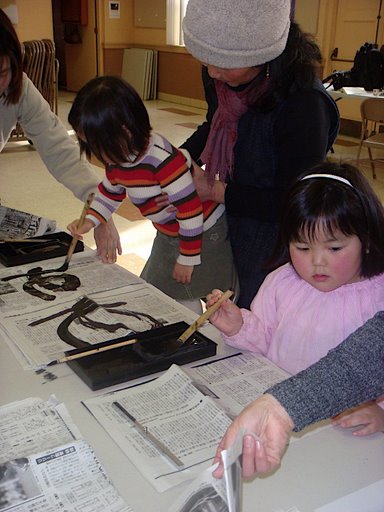
In Japan, some people observe "kakizome" on the second day of January (which may or may not be the first day back at school, now that I think of it). It's basically a calligraphy exercise: people write a phrase or poem using brushes & ink. It's very similar to the Chinese New Year tradition of writing lucky words on red paper - except that the Japanese tend to use white, or cream, colored paper.

The Russians eat meat and potato dishes. Care for kartoshnik, students?

The Danes like to save old dishes, probably chipped ones, throughout the year, then throw them at their friend's homes on the 31st. So you know you have a lot of friends when you find a huge pile of broken dishes on your front step in the morning. I can make it work with some modifications - perhaps taking broken dishes and cementing the pieces into a mosaic?

Carnivals ring in the South African new year. This can be a school-wide, or even community wide, event. Lots of coordination, lots of work, but probably really, really fun.

For a more scientific approach, like the Germans, I could melt metal and drop it in buckets of water to tell fortunes for the coming year. According to this, if the metal comes out in a shape of a pig, then your year will be full of plenty.

Photo from here.

Most of the ideas I got from this site deal with non-January 1 New Year's events. Actually, I suppose most of the world's traditional new year begins with the coming of spring and the end of winter.

Hm, perhaps an even more academically acceptable activity would be to study the different types of calendars. It'll be interesting for students to figure out where their birthdays fall on say, the Julian calendar, or the lunar calendar.

Wednesday, December 30, 2009

Things I did in 2009

Doesn't necessarily make the picture clearer, but that's ok.

At the end of each lesson (usually at the end of each school day in the primary grades), good teaching requires a "closure." It can be a 20-30 second spiel about what the lesson was. It could be a review in the form of a quick write, a "ticket out the door" deal, or even simpler, just having the students tell me when they learned that day.

Throughout the credential program (and from what I can tell, well into BTSA as well) professional and personal reflection has such a high priority. Which I get - but there needs to be a point to it too. Reflection not for reflection's sake, but for change. For making my teaching more effective. For making peace with all the sadly ironic things about teaching. For making peace with my own decisions before, during, and after teaching.

The first step to a thoroughly productive reflection is just to recall what happened. Here's my first step for the past twelve months:

Things I did in 2009

1) Lost 25 pounds. Most of it during the stress of my failed seven weeks of Phase 3, the first time around.

2) Gained back 15 pounds. Most of it during my month long vacation in HK.

3) Was withdrawn from student teaching. Cried in front of everyone and their principal.

4) Survived complete change of teaching philosophy with integrity intact and determination rejuvenated.

5) Took three travel vacations, and one big stay-cation, over a span of five months to get over those seven weeks. Best decision this year.

6) Attended four weddings. Felt that much older.

7) Drove 19,782 miles, including a road trip to WA.

8) Got much better at tennis.

9) Learned that sometimes, giving less than 100% is more effective - and sanity saving - than giving more.

10) Taught the best group of fifth and sixth graders that I will ever see in my entire future career.

11) Passed the RICA, PACT, and finally the credential program at CSUS.

12) Adopted a pet.

13) Planned and initiated goals for blog.

14) Learned to crochet.

15) Moved away from the polo-shirt-and-khakis combo and into more experimental fashion territory.

16) Increased financials. Good investment.

17) Kept up correspondence with far-flung friends. Better investment.

18) Made decisions that made me happy. Best investment.

19) Was astounded by the huge world of blogs.

Now what am I going to do with this reflection? That'll take more reflection. Yeah, of course it does.